/ Catalog / Electrophysiology / npi EPG-12

- Our e-mail:
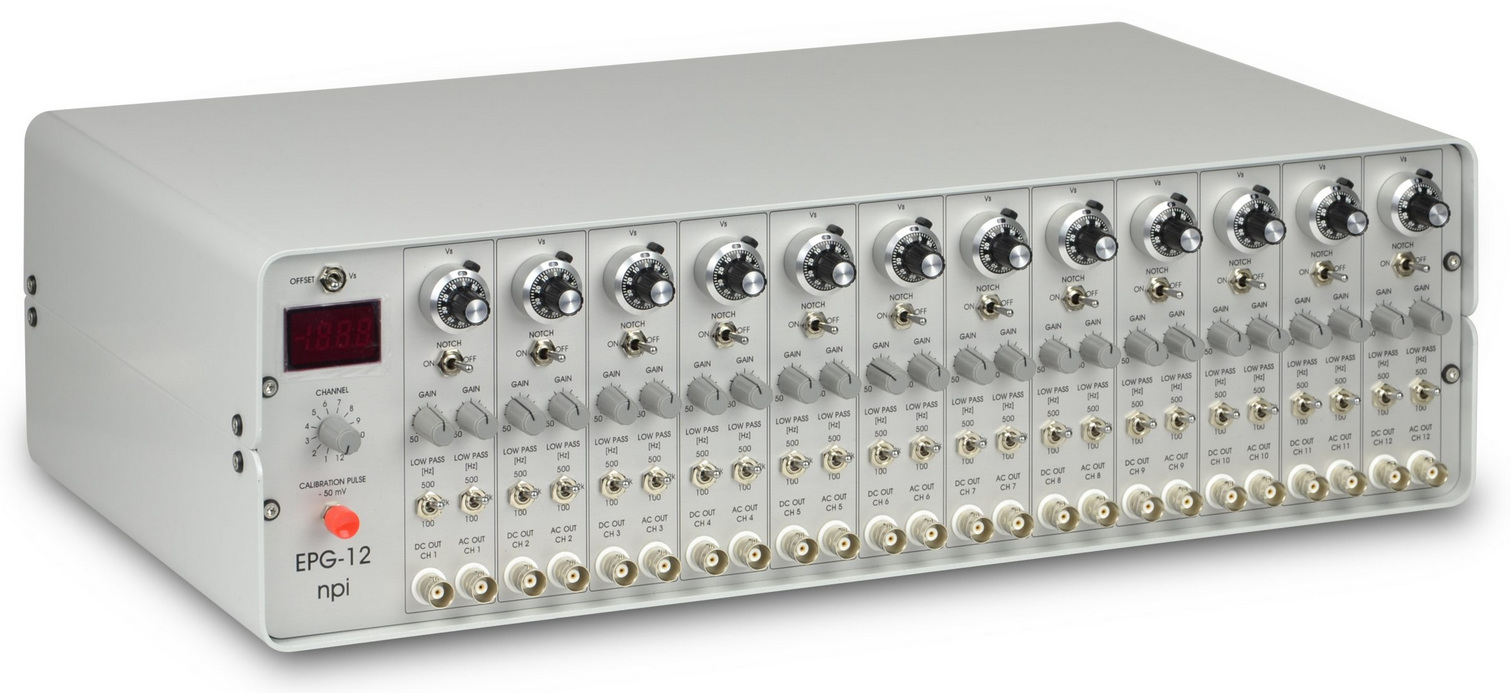
EPG-12 amplifier for electrical penetration graph
EPG-12 Electrical Penetration Graph (EPG) Amplifier is suitable for electrophysiological recording of insect feeding and probing behaviour on plants.
- Overview
- Specifications
- Links
Key Features:
- 12 independent recording channels
- AC and DC recordings
- Gain 50 … 550
- Lowpass filter for AC and DC
- Notch filter (50 Hz or 60 Hz)
Electrical Penetration Graph (EPG) Recording: Operational Principles
Electrical Penetration Graph (EPG) recordings are utilized to quantify the penetration and feeding mechanisms of insects possessing piercing mouthparts, including aphids and leaf bugs.
A voltage source (alternating or direct current) is connected to a soil electrode positioned adjacent to the plant's root system. A thin gold wire is affixed to the insect and linked to a preamplifying headstage. During insect feeding on plant tissue, a minute electrical circuit is established. Electrical signal variations originating from the plant and insect can be measured:
- EMF – electromotive force: predominantly resulting from fluid movement within the insect's stylet, generating "streaming potentials".
- R-components: resistance variations, primarily influenced by valve position changes in the insect's feeding canal.
Direct Current Recording – Biological Voltage Measurements
- Employs an adjustable constant voltage
- Quantifies EMF and R-components
- Identifies physiological occurrences (cellular penetration, consumption, salivation)
- Optimal for comprehensive feeding examination
Alternating Current Recording – Resistance Fluctuations
- Employs an adjustable alternating voltage
- Quantifies R-components exclusively
- Emphasizes mechanical feeding behavior
- Dependable and consistent for extended recording periods
npi's EPG-12 instrument is capable of recording in both alternating current and direct current modes.
You can also visit site of the manufacturer.

We are a distributor of NPI Electronic GmbH in Estonia, Latvia, Lithuania and Ukraine, Kazahstan and Europe